CoilStellaration: teaching machines to wind coils around a star
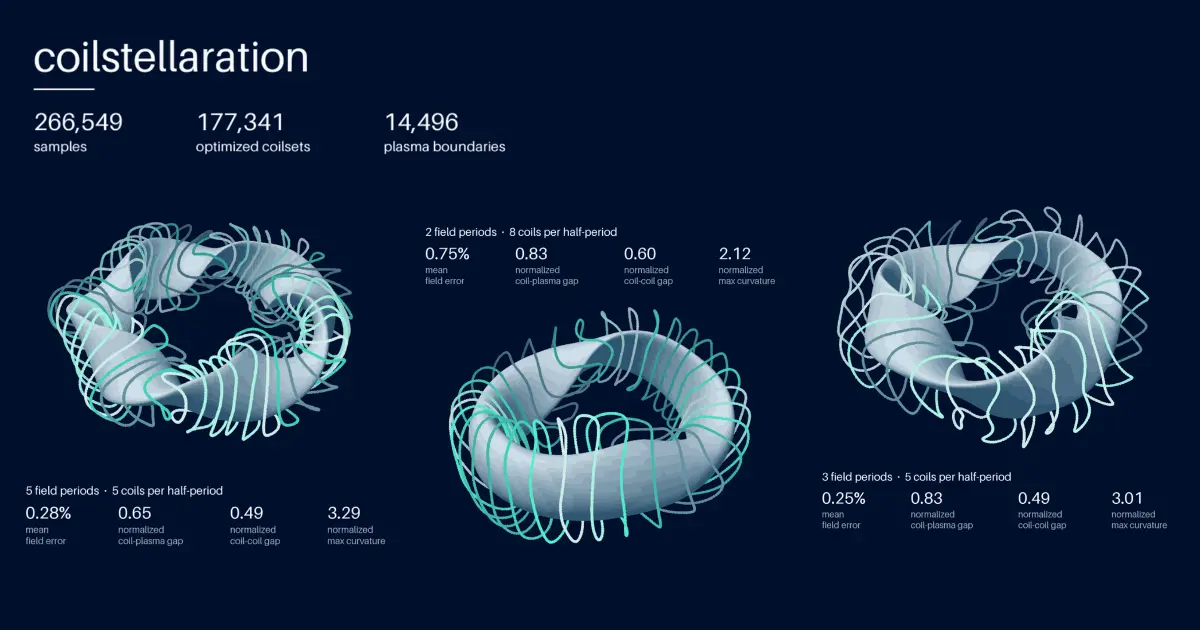
Today we're releasing CoilStellaration: an open dataset of 177,341 optimized stellarator coilsets, a machine learning benchmark for coil generation, and a live leaderboard on Hugging Face. It's an open invitation. Pull the data, try to beat our baseline, and put your score up. We'll be watching.
To put this into context: stellarator coils have to reproduce an exact magnetic field, but there's no unique shape that does it. So we're using machine learning to bend magnets into a thousand different, seemingly improbable, shapes to solve it. My team and I have spent the last few months on this, and I’m delighted that I’ll be presenting the dataset and our results at NeurIPS. But what excites me most is something else. In an age of benchmarks that get saturated within months, we've put together one that is nowhere near saturated.
A bit of background on me: I did my PhD in reinforcement learning, teaching drones and search algorithms to find lost hikers in the Scottish hills autonomously and at a fraction of the cost of a helicopter. Applied ML, chaotic real-world systems, reward functions that are a pain to debug and interpret - that was my world for years. These days I'm part of a team doing something similar, except what we're trying to design is a set of electromagnetic coils that will confine a plasma hotter than the surface of the sun.
So: CoilStellaration. Here's why it matters, and why I think it's one of the more exciting things happening in stellarator research right now. Not because of the NeurIPS paper itself, but because of what it represents: the ability to shape how this field gets built, from the ground up.
Quick recap on the first act: from ConStellaration to CoilStellaration
Last year, Proxima teamed up with Hugging Face to launch ConStellaration, an open dataset and benchmark challenge inviting the global ML community to help optimize stellarator plasma configurations. That was step one of a much bigger plan. Stellarators are magnetic confinement devices, and getting commercial fusion onto the grid means nailing a long list of things about them, but here are the two we're starting with. First, the shape of the plasma itself – what we often call a "plasma configuration". ConStellaration handled that part. Second, the actual physical coils that generate the magnetic field holding that plasma in place, whilst meeting insane engineering requirements. CoilStellaration deals with that second part and it's where things get properly hard.
Why stellarator coil design is the hard part
One key thing to understand about stellarators is this: once you know the coil shapes you want, figuring out the magnetic field that produces it is (relatively) easy. That's a well-posed problem. But going the other way - starting from "I need this magnetic field" and asking "what coils produce it?" - has no unique answer. Infinitely many coil geometries (each one really just a loop of superconducting cable) can generate the same field. They differ in length, curvature, how close together they sit, how close they get to the plasma. And every single one of those properties is constrained by something real and unglamorous: can you actually manufacture this cable, can a person or robot physically assemble it, does it leave enough room for the diagnostics and support structure you also need to cram in there.
So coil design is this beautiful, horrible, underdetermined inverse problem sitting right in the middle of the difference between having a physics solution and having an engineerable machine. It's one of the reasons stellarators have lived in the shadow of tokamaks since the 1950s, if you ask me. Wendelstein 7-X showed the physics works. Turning that physics into hardware that's actually buildable and economical is, for lack of a better term, savage.
My kind of thing. It's the kind of challenge that's perfect for a data-driven approach, and exactly the kind of problem nobody had released a proper large-scale dataset for.
What we built: an open stellarator coil dataset
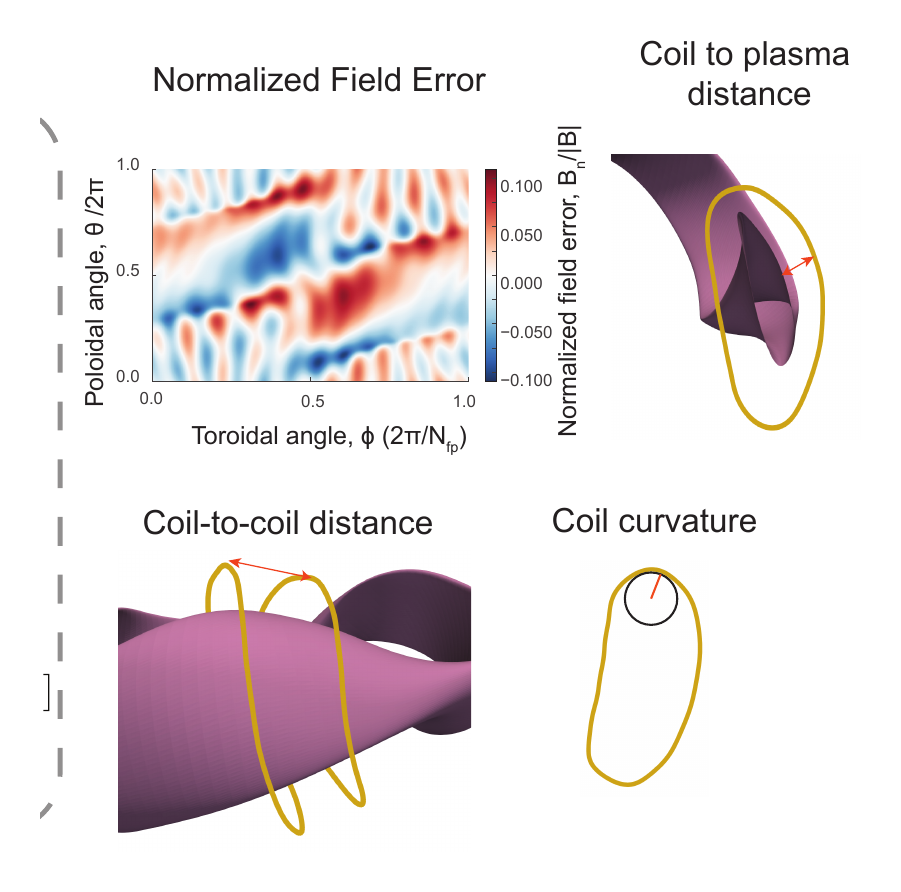
A small team of us built a dataset of 177,341 optimized stellarator coilsets (a coilset is the full set of coils around one plasma shape) - 266,549 samples in total, covering 14,496 unique plasma boundaries pulled from ConStellaration. Each one comes with a full slate of engineering requirements sampled to be representative of everything from small experimental devices to full reactor-scale machines. Coil-to-coil spacing, coil-to-plasma distance, maximum curvature, the works.
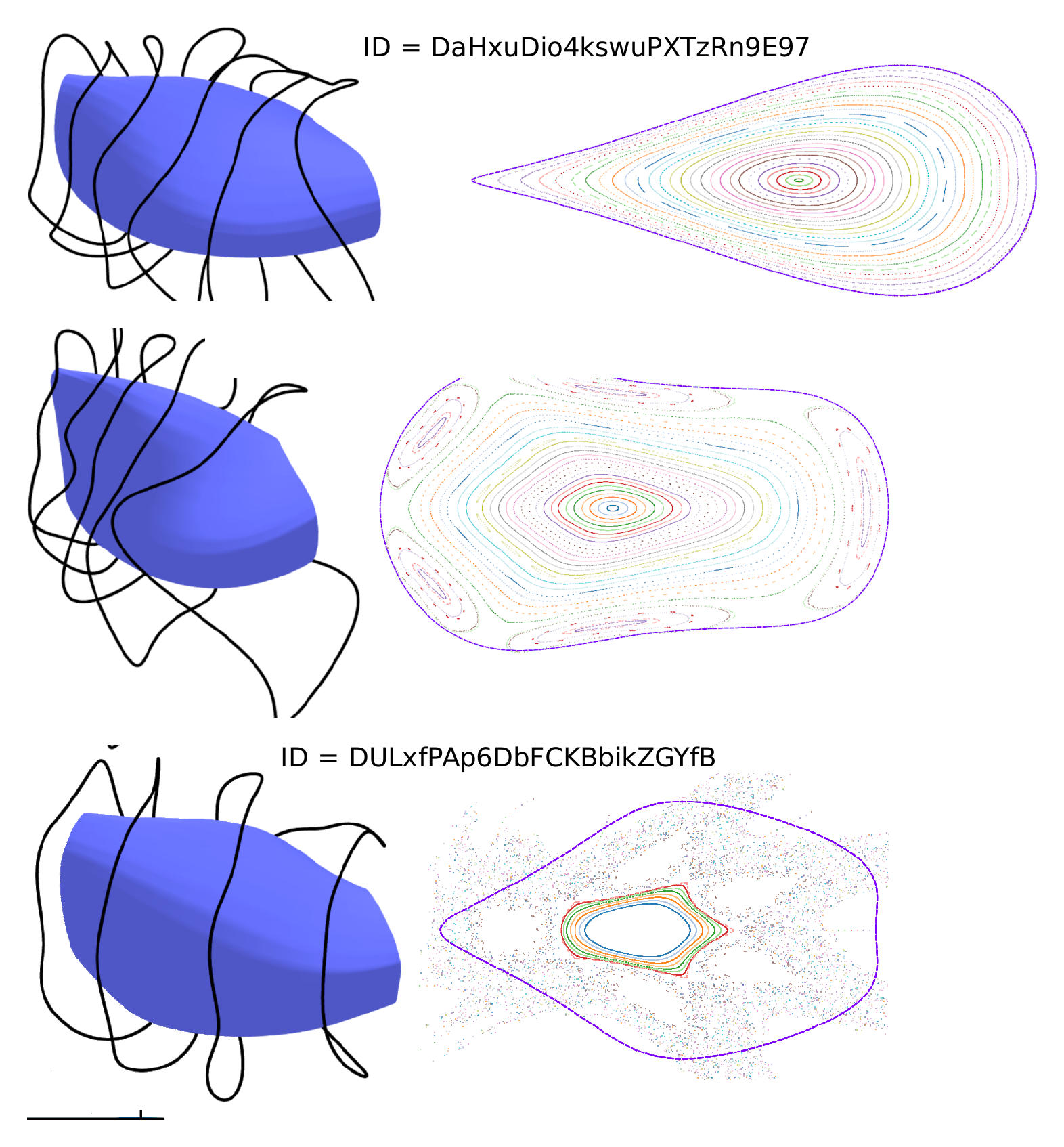
We generated these with a two-stage pipeline: a fast REGCOIL warm start, followed by proper constrained optimization using DESC, balancing magnetic accuracy against total coil length and every one of those engineering constraints simultaneously. It's one of the largest engineering-aware coilset resources that's ever existed for this class of quasi-isodynamic stellarator.
The benchmark: can a model design coils in a single forward pass?
Alongside the dataset, we built a benchmark that I think is the more interesting bit. The task: given a target plasma shape and a set of engineering requirements, can a model output a coilset that meets those requirements in a single forward pass, with no expensive optimization loop at inference time? Because right now, every time you want to explore a design trade-off, you pay for a full optimization run. If a model could just … know what a good coilset looks like, straight away, that collapses days of computation into a single query. But even where a model's output isn't perfect on its own, it doesn't have to replace the optimization - it can seed it.
Now, I'll be honest with you, our baselines are not great yet. The best of our four architectures scores 0.13 out of 1.0 on our overall feasibility score, and only 4.4% of its coilsets meet every constraint outright. That is not a typo, by the way, it's genuinely humbling. Which is the point. This benchmark is hard by design, and the fact that our models can already get the plasma-distance and curvature limits mostly right, but still struggle to nail the magnetic field itself is an incredibly useful, very specific thing to know. It tells the whole community exactly where the next breakthrough needs to happen. That's worth more to me than a benchmark everyone saturates in six months.
Why this isn't "we solved stellarators." And why that's fine
Why are we releasing this data set? We want to hand the ML community a new tool to test ideas against. Even a few hours poking at this dataset can tell you "no, that design direction is wrong" in a way that would previously have taken days of modelling and optimization to find out. That compression, from days to hours, is the whole game when you're trying to iterate on reactor engineering.
And this is a milestone for more than one field at once.
- It's a big deal for machine learning, because it's a genuinely hard, physically-grounded benchmark with real structure to it.
- It's also a milestone for the broader stellarator tooling ecosystem - DESC, SIMSOPT, and the other open-source tools people already use - because CoilStellaration was built with and on top of them, not around them. Anyone already working in that ecosystem can pick this up and go.
- It's a big deal for coil engineering, because it's the first large-scale dataset built around a diverse spread of engineering requirements, with a standardized way to check whether generated coils actually meet them. Once you have a fast, data-driven handle on what the coils look like, everything that has to physically fit around them becomes a much more tractable question.
What's next for CoilStellaration
We want to grow this properly as a community resource. The Hugging Face leaderboard is live and we are actively putting extra weight behind it, making it the place people go to benchmark coil-generation models against each other and against us. Every metric we computed during generation ships with the release too, so you don't have to burn your own compute re-deriving numbers we've already worked out. That's the whole spirit of releasing this in the first place. Lower the barrier, let more people in, and get to engineerable, cost-effective stellarator power plants faster.
Thanks for reading, and we hope you'll go poke at the dataset yourself - it's on Hugging Face, the code's on GitHub, and the paper is on arXiv. Build something better than our 0.13 baseline and get in touch with us once you do.
- Jan
Frequently asked questions
What is CoilStellaration?
CoilStellaration is an open dataset and machine learning benchmark for stellarator coil design, released by Proxima Fusion. It contains 177,341 optimized coilsets, each paired with engineering requirements and the metrics the coils achieved, plus code to score models on how well they generate new coilsets.
What is a stellarator coilset?
A coilset is the full set of electromagnetic coils placed around one plasma shape. Together the coils generate the magnetic field that holds a stellarator's plasma in place. In CoilStellaration, each coil is a closed loop of cable described by a Fourier series.
Why is stellarator coil design so hard?
Going from a target magnetic field to coils is an inverse problem with no unique answer: infinitely many coil shapes can produce the same field. Each candidate also has to meet engineering limits such as coil-to-coil spacing, distance to the plasma, curvature and manufacturability, which makes the search space large and constrained.
What is in the dataset?
The dataset has 266,549 samples, 177,341 optimized coilsets and 14,496 unique plasma boundaries taken from ConStellaration. It covers two to five field periods and four to eight coils per half period, and every sample includes sampled engineering requirements and the metrics computed during generation. It is on Hugging Face under an MIT license.
How was the dataset generated?
Each coilset starts from a fast REGCOIL solution and is then refined with constrained optimization in DESC. The optimization balances magnetic-field accuracy against coil length and the engineering constraints at the same time.
What does the benchmark ask models to do?
Given a target plasma boundary and a set of engineering requirements, a model must predict a coilset in a single forward pass, with no optimization at inference time. Requirements cover coil-to-coil spacing, coil-to-plasma spacing, maximum curvature and magnetic-field error. There are two tracks: a fixed-shape track and a variable-shape track.
How is the benchmark scored?
Each requirement gets a soft score from 0 to 1 based on how closely the predicted coilset meets it, and these are combined with a geometric mean. The leaderboard also reports the share of coilsets that meet every constraint, which is called strict feasibility.
Why are the baseline scores so low?
The benchmark is hard by design. The best baseline scores 0.13 out of 1.0 and meets every constraint on 4.4% of cases, almost all of them with loose requirements. Magnetic-field accuracy is the main failure; plasma-distance and curvature limits are mostly met.
Can machine learning replace coil optimization?
Not yet, and these coilsets are starting points, not final designs. In our tests, starting the optimization from a model's prediction made faster early progress than starting from REGCOIL, which helps when compute is limited. The conventional start catches up on score with more iterations.
How does CoilStellaration relate to ConStellaration?
ConStellaration, released with Hugging Face last year, covers the shape of the plasma. CoilStellaration covers the coils that produce the field holding that plasma, and its boundaries come from the ConStellaration dataset.
How do I get started?
Download the dataset from Hugging Face, clone the code from GitHub, and read the paper on arXiv. The repository includes examples for generating coilsets with REGCOIL and DESC, training a baseline model and scoring a submission.
Related Stories