My Shift from Tokamaks to Stellarators
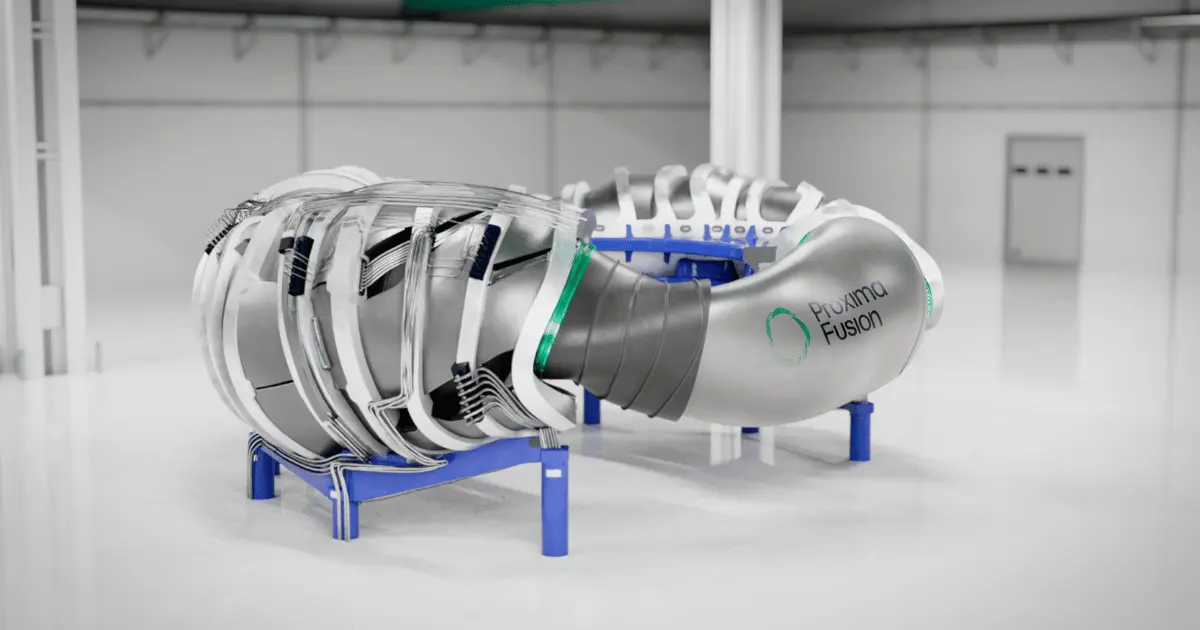
Fusion is a field of believers, some more religious than others. I believe in the promise of fusion today more than I ever did, but my views have changed significantly over time. My shift from tokamaks to stellarators is most evident.
Tokamaks and stellarators are both magnetic-confinement fusion devices, but they differ in one fundamental choice: a tokamak is a doughnut-shaped device that confines its plasma using a large electrical current driven through the plasma itself; a stellarator takes a different route - it creates its entire magnetic cage using external coils alone, with no current needed inside the plasma. See Ben Miles’ recent video, which nicely explains the two concepts.
This blog post addresses questions I’ve received many times over the past 3 years.
Until a few years ago, all my research was focused on tokamaks. My undergrad thesis was on the TCV tokamak in Lausanne, and my PhD at MIT was on particle transport in tokamak plasmas, focusing on Alcator C-Mod and DIII-D. I later worked on ASDEX Upgrade at the Max Planck Institute in Germany, and for a time I served as one of the European scientific coordinators for tokamak research. Tokamaks shaped how I think about plasma physics, and taught me much of what I know about fusion.
So when I say that stellarators are the better bet for a fusion power plant, I'm saying it as someone who spent years working on the alternative, and changed his mind.
What tokamaks taught me about fusion
Decades of experiments across hundreds of tokamaks worldwide have produced an extraordinary body of knowledge – about plasma stability, heating, transport, materials, diagnostics… the list goes on. JET set records. ITER is being built. The tokamak community has gone further and into more detail than any other in fusion, and I'm proud to have been part of it.
But working on tokamaks also meant working within their constraints – and over time, those constraints started to look less like problems to solve and more like consequences of a fundamental design choice.
The core issue is that a tokamak confines plasma by driving a large electrical current through it. That current is essential because it helps create the magnetic cage that holds the plasma in place. But that same current also introduces instabilities. Push the plasma density too high and you hit the Greenwald limit. The Greenwald limit is a well-known ceiling set by the plasma current and the size of the machine, above which a tokamak tends to lose control of the plasma. Cross it, and the plasma can violently disrupt, meaning the confinement collapses and the energy stored in the plasma is dumped into the surrounding surfaces and structures, potentially damaging the device permanently. Operating a tokamak near peak performance means navigating this tension constantly. Worse yet: there’s no assurance that operating away from peak performance keeps you “safe”, because it’s easy for a sudden impurity source, e.g. from a damaged tile on the first wall (sometimes referred to as a “Unidentified Flying Object” – UFO), to stir up the plasma enough to send the current, and the plasma that it helps confine, into “bang” mode.
I spent a fair amount of time studying particle transport in these conditions. The physics is fascinating. But at some point, I started asking myself if this is the machine I'd want to run as a power plant for 40 years.
The answer came into focus when I started looking seriously at stellarators and especially the Wendelstein 7-X (W7-X).
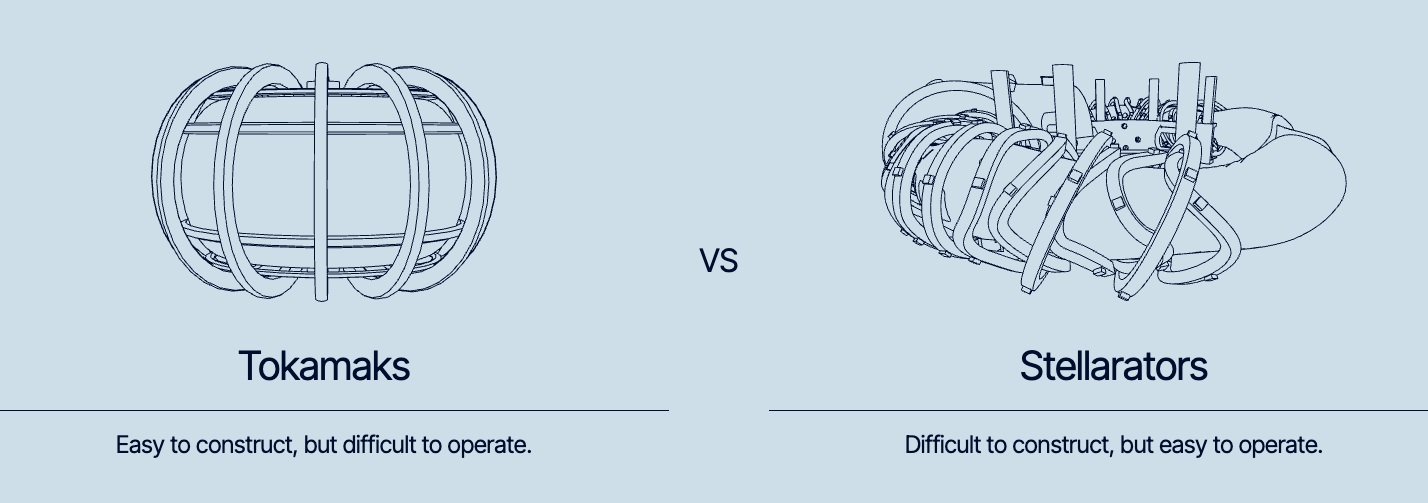
The difference between a tokamak and a stellarator comes down to a single design choice: where you put the complexity. A tokamak is simple to design but hard to operate, because its magnetic cage depends on a plasma current that must be actively sustained and carefully controlled. That current is a key part of the confinement mechanism, but it’s also the biggest liability. Everything I described a moment ago: the disruptions, the density limit, the constant real-time control, traces back to it. You can’t remove those instabilities without removing what makes a tokamak work.
A stellarator is harder to design, but simpler to operate. Its magnetic cage is created entirely by external coils. In a quasi-isodynamic (QI) stellarator, – the type pioneered by W7-X at the Max Planck Institute for Plasma Physics, which Proxima Fusion originally spun out from – there is zero net toroidal current in the plasma. No induced current, no current-driven instabilities and therefore no disruptions. The tokamak’s single most damaging failure mode doesn’t exist in a stellarator. Push a stellarator past its density limit, and the plasma doesn’t disrupt. It simply cools and fades calmly. No catastrophic failures involved, so you turn it back up. That difference is decisive for a power plant, which needs to run continuously and reliably for decades.
Here's the tokamak vs stellarator comparison that changed my mind:
When you’re building a power plant, you want the complexity front-loaded into the engineering, not embedded in the operations. You want to solve the hard problems once, in the design phase, rather than solving them every second the machine is running.
The stellarator requires harder engineering upfront so that the machine is inherently simpler to operate, and that is exactly the right trade-off for a commercial power plant.
What changed to make stellarators a leading fusion concept
For decades, that harder engineering was too hard. Stellarators were beautiful in theory but brutally difficult to design and build in practice. Their three-dimensional geometries are complex. Small changes in shape can have large effects on performance. You couldn't iterate through prototypes the way you could with tokamaks, because each machine took too long and cost too much to build.
Three things changed that calculus.
First, Wendelstein 7-X proved it works. Wendelstein 7-X, built with over €1.4 billion in investment and operated by the Max Planck Institute for Plasma Physics, demonstrated that the manufacturing precision required for an optimized stellarator with twisty coils is achievable. This validated the entire theoretical framework that optimized stellarators are built on. Crucially, W7-X demonstrated the QI stellarator principle: no disruptions, steady-state and “simple” operation.
Second, the same AI revolution now reshaping software reached stellarator optimization. The numerical tools and computing resources to design optimized stellarators at the required fidelity simply didn't exist ten years ago, but they do now. We’re able to train surrogate models that stand in for our most expensive physics simulators, so we can evaluate millions of candidate configurations instead of a few hundred, weighing plasma performance, manufacturability, and machine cost against each other. Work that used to mean years of building and testing one configuration at a time now happens in days of virtual optimization. Breakthroughs in stellarator optimization – showing that stellarator plasmas can be designed to exhibit precise magnetic symmetries – opened the door to a new class of configurations that are practically buildable.
Third, none of this would matter for commercialization without high-temperature superconducting (HTS) magnets. HTS technology allows us to generate far stronger magnetic fields in more compact geometries. A decade ago, HTS tape was essentially a laboratory material, made in tiny quantities by a handful of specialists. Today it's an industrial product manufactured worldwide, and the price has fallen roughly by half with every tenfold increase in production. The shift from ‘exotic’ to ‘buildable’ is what turned HTS from a physics curiosity into the foundation of a power plant. When you combine an optimized QI stellarator design with HTS magnets you get a device that is dramatically more compact and powerful than anything previously imagined. This is the leap that we at Proxima are making from W7-X to Alpha and ultimately, to Stellaris.
Worth mentioning: tokamaks have toroidal field (TF) coils to generate the main confining field, poloidal field (PF) coils to shape the position of the plasma, a central solenoid to help drive the current plasma current, and many control coils - some running on direct current (DC), some on alternating current (AC). QI stellarator power plants, on the other hand, will have only one type of coil — in a few different shapes, but fundamentally just one type. And it's DC, no AC. So, it's not so obvious whether tokamaks or stellarators are really more complex, is it?
The three developments above – physics validation, simulation-driven design, and HTS industrialization – converged in 2022, and that convergence is why we founded Proxima Fusion.
The power plant argument for stellarators
The advantages of a stellarator translate nicely into economics.
No plasma current means no catastrophic disruptions. It also means that the maximum density is a calculable engineering parameter, determined by heating power and microwave heating accessibility. This matters enormously for the economics of fusion power. Fusion power density scales with the square of plasma density: double the density of the plasma and you get 4x the power output per unit volume. The physics of W7-X suggests QI stellarators can operate at roughly 3x the density of a comparable tokamak, which translates to 9x the fusion power from the same volume. That means a more compact core and lower capital cost, which eventually leads to cheaper power generation.
No plasma current also means true steady-state operation. Once you turn a stellarator power plant on, it can reliably run for years at a time with lower material fatigue, i.e. the progressive weakening and fracturing of materials when subjected to repeated cycles of loading and unloading. In the long run, I’m convinced that lower material fatigue will be a major advantage of stellarators compared to not only tokamaks but every pulsed fusion concept.
A machine that is inherently stable, reliable, and longer lasting is a machine you can build a business case around.
The future of fusion power plants
The tokamak community will continue to make critical contributions to fusion science. ITER will generate important data. The physics insights from decades of tokamaks being built across the world are embedded in everything we do at Proxima, including in the way we model and optimize our stellarators. I carry that work with me.
But when I ask myself what kind of machine I want to build, operate, and stake a new industry on – a machine designed to produce electricity reliably and economically for decades – the answer is a QI stellarator. We have a solid physics basis, the engineering is now solvable, and the economics are compelling. And the team we've built at Proxima, standing on the shoulders of our Max Planck partners, is executing on an extremely ambitious timeline to deliver commercially viable fusion power, and not just headline grabbing Q>1 vanity metrics.
Ultimately, tokamaks taught me how fusion works, but stellarators show the way we will build fusion power plants at scale;
FAQ
What is the difference between a stellarator and a tokamak?
Both are magnetic confinement fusion devices. A tokamak confines plasma with a large electrical current driven through the plasma. A stellarator uses only external coils and carries no net plasma current. Tokamaks are simpler to design, but prone to disruptions. Stellarators are harder to design, but inherently more stable to operate.
Why do stellarators not disrupt?
Disruptions in a tokamak are driven by the large electrical current flowing through the plasma. A quasi-isodynamic stellarator carries no net toroidal plasma current, so current-driven instabilities can’t occur. Pushed past its density limit, a stellarator plasma cools and fades rather than disrupting violently. Note that not all stellarators are “QI” and those stellarators do present significant toroidal currents, making them at risk of disruptions of similar scale to tokamaks.
What is the Greenwald limit?
The Greenwald limit is an empirical maximum plasma density for tokamaks, identified by Martin Greenwald in 1988. It is set by the plasma current and the machine's minor radius (n_G = I_p/πa²); above it, a tokamak tends to lose control of the plasma and disrupt. Because a QI stellarator carries no plasma current, it’s not bound by the Greenwald limit. The maximum density of a QI stellarator is simply set by the ability to sustain power flows in balance in the magnetically confined plasma.
What is a QI stellarator?
A quasi-isodynamic (QI) stellarator is a class of optimized stellarators pioneered by the Max Planck Institute for Plasma Physics. In a QI stellarator like W7-X, 3D magnetic fields are shaped to carry zero net toroidal plasma current. This eliminates current-driven disruptions and enables steady-state operation. Proxima Fusion is building QI stellarators, commercializing the concept by using high-temperature superconducting (HTS) magnets.
Why are stellarators viable now when they weren't before?
Three developments converged in the early 2020s:
- Wendelstein 7-X validated that an optimized stellarator can be built to the required precision
- Computing power and AI finally made the 3D optimization problem solvable, allowing us to address historical bottlenecks of stellarator physics, and
- High-temperature superconducting (HTS) magnets became an industrial product, enabling far more compact, powerful machines.
What types of magnetic coils do tokamaks and stellarators use?
A tokamak relies on several distinct coil systems working together: toroidal field (TF) coils, which generate the main magnetic field confining the plasma around the torus; poloidal field (PF) coils, which shape and position the plasma within that field; a central solenoid, which inductively drives part of the plasma current itself, transformer-style; and a set of additional control coils that fine-tune plasma position and stability in real time. Some of these systems run on steady direct current (DC), while others - particularly those involved in driving or adjusting the plasma current - operate on alternating current (AC).
A QI stellarator power plant, by contrast, needs fundamentally only one type of coil. It comes in a few different non-planar shapes to produce the full 3D magnetic field, but it's a single coil system rather than several separate ones, and it runs entirely on DC. No AC coils are required at all, since the confining field comes purely from the external coils rather than from driving current through the plasma.
Related Stories